
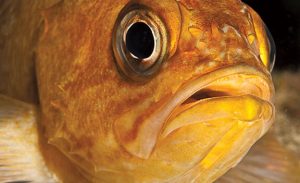
 Fish fanatics. That term is an apropos way to describe a lot of divers. Those of us that fit the description love the seemingly endless variety of shapes and colors found in fishes. We are fascinated by their antics and the ways some species blend into their environment while others standout. We get a charge out of learning about and watching their courtship rituals, displays at cleaning station, the challenge of trying to identify and photograph them, and so on and so forth. But ask many fish fanatics exactly what makes ichthyologists classify creatures as varied as a garibaldi, moray eel, pygmy seahorse, and whale shark all under one roof, and you will probably see a lot of head scratching.
So, let’s dive into the world of fishes. Whether or not you think of yourself as a fish fanatic, I hope your appreciation for these aquatic wonders will deepen from the presented information.
Classifying Fish: The Big Picture
Many species of fishes that are known to exist are yet to be classified, and new species are being discovered on a regular basis. Tragically, some are becoming extinct; and much of the deep ocean has yet to be well explored. These and other factors make it impossible for anyone to state with absolute certainty the exact number of fish species in the world today. Suffice it to say, it is generally agreed upon that the number is somewhere north of 24,600, and some specialists believe almost twice that number to be more accurate.
Ichthyologists define fishes as cold-blooded, finned, aquatic vertebrates that respire by passing oxygenated water over gills. Specialists classify all currently living fishes in two superclasses that are further sub-divided into four classes. The superclass Gnathostomata, the vertebrates with jaws, includes all of the world’s cartilaginous fishes (sharks, rays and skates) as well as all fishes that have skeletons made of bones. In turn, all sharks, rays and skates are further described in the class Chondricthyes while those species with bony skeletons are described in the class Osteichthyes. More than 95 percent of all known fish species are bony fishes.
The superclass Agnatha includes the hagfish (class Myxini) and lampreys (class Cyclostomata). These fishes lack jaws, and most sport divers will never have any contact with them in the wild.
Where Fishes Live
Some fish species can be found in almost every permanent body of naturally occurring water on earth. A number of factors ranging from water temperature, salinity and depth to the amount of available sunlight and food play fundamental roles in determining where various species occur. As mere humans, we might not see or feel these factors, but the lives of fishes depend on their ability to respond and adapt to them.
All fishes must create an osmotic balance between the tissues in their body and that of the surrounding water to maintain within acceptable parameters for the proper levels of fluids and electrolytes in their bodies so they can survive. We often think of fishes as living in either saltwater or freshwater, but that is not the case. Species such as mullets, flounders, halibuts, soles, turbots, and snooks live in estuaries and other brackish water regions where the percentage of salt in the water changes according to the tidal flow and the influx of freshwater due to storms and floods.
In contrast, salmon, sturgeon and some trouts among other species live the majority of their lives in saltwater environments but swim up streams that are mostly freshwater to spawn and lay their eggs. These species are said to be anadromous. Other fishes including a variety of eels do the exact opposite living the majority of their lives in freshwater, while entering saltwater to spawn. They are said to be catadromous.
Fish Senses
As is the case with all vertebrates, fishes are equipped with sense organs that inform them about their surroundings. These organs enable fishes to see, hear, smell, taste and touch.
Generally speaking, the sense of sight is well developed in fishes, although different species depend upon sight to significantly different degrees. Speaking in general terms, species that live in relatively clear, shallow water such as giant kelpfish and señoritafish likely benefitting more than others. Many eels provide exceptions to this statement. Some fishes that live all, or the vast majority, of their lives in caves, or deep, dark waters such as a variety of brotulas, including the rarely encountered purple brotula found in California waters, are blind, or nearly blind.
While fishes lack outer ears and eardrums, they do hear sounds as vibrations that are transmitted from their surroundings into and through their body tissues. The sense of smell is highly developed in sharks, eels and many other species, but much less so in others. In the majority of fishes, olfactory organs on each side of the snout that look like small nostrils are lined with nerves that are very sensitive to odors in the water. Smell and taste are closely related, and most fish have some taste buds in their mouths. However, in many fishes the sense of taste is much less well developed and not as heavily relied upon as many people suspect it is.
Many fishes are extremely sensitive to touch, and they will quickly flee upon contact with a foreign object. All possess a system of nerves called the lateral line that runs down the midlines of the outside of the body. Nerve endings in the lateral line system are sensitive to changes in pressure caused by movement of nearby animals and objects. In essence, the nerves in the lateral line system allows fishes to “touch” objects and animals that they are not in direct contact with.
All sharks, rays and skates are equipped with gel-filled pit organs known as ampullae of Lorenzini that help these fishes detect electrical fields produced by biological functions such as the heartbeat and contracting muscles of nearby animals. The organs in this “sixth sense” are concentrated in the snout, but that run the length of the body. With a careful look, they can be seen by the naked eye. This sense is well developed and greatly assists cartilaginous creatures in their effort to detect potential prey and other nearby animals. The organs are not found in bony fishes.
How Fishes Swim