
The California sheephead is one of three species of wrasses that are commonly encountered while exploring California’s reef communities, kelp forests, and nearby sand flats. When I travel the world and encounter other wrasses, I often find myself thinking about and comparing some aspect related to appearance, behavior, or life cycle of the fish I am seeing to that of the California sheephead. That has been the case more than once when I have been fortunate enough to encounter a slingjaw wrasse, which I’ll cover in our companion column, Beyond the Bear. These species share some fascinating traits in common as well as some significant differences.
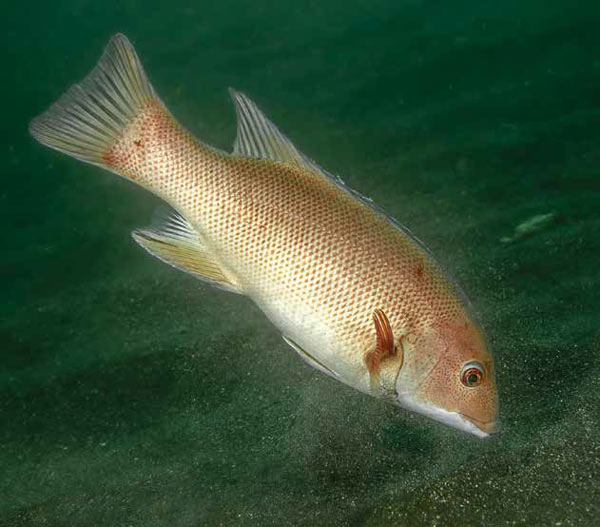
During the day, California sheephead, like the female seen here, feed on a mix of sea urchins, lobster, crabs, bryozoans, bivalves, and barnacles.
Photo by Marty Snyderman.
FAMILY: Labridae
GENUS AND SPECIES: Semicossyphus pulcher. The genus name Semicossphus is derived from the Greek language, with semi meaning half and kossyphos meaning kind of fish. The word pulcher is derived from Latin for beautiful.
DESCRIPTION: Describing any wrasse is a challenge because juveniles, females, and males are not only different sizes, but they display dramatically different body colors and patterns. Juveniles are as small as the palm of your hand. Their elongate bodies are varying hues of brick red to bright reddish orange to a salmon hue seen in a small subset. Juveniles are further characterized by a whitish stripe that runs horizontally along the length of their mid-body from just in front of the tail past the eye to the front of the face. In addition, they display a single, large bluish-black spot on each fin with another above the white line at the base of the tail.
Females are significantly larger than juveniles, but they are considerably smaller and sleeker than even medium-sized males. The body color of females is a reddish orange that is duller than that of the juveniles. Females have a whitish lower belly. The lower jaw is bright white.