
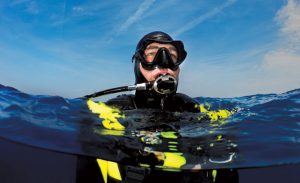
 The rich California coastline offers a bounty of marine life and a range of dive locations to suit every diver. We’ve got kelp beds, rocky reefs and wrecks. We’ve got offshore islands reachable only by boat, and we’ve got some spectacular shore diving, too. We can hunt and collect our dinner, or capture stunning images with a camera. In other words, we’ve got options. When it comes to equipping ourselves with the proper exposure protection needed for safely and comfortably exploring our decidedly temperate waters, we’re lucky that we’ve got plenty of options in that area, too. Even though California is sunny and warm our waters aren’t. But that’s no reason for any diver to complain, “It’s too cold to dive here.” We’re calling baloney on that kind of talk. All you need to do is select thermal protection that supports your personal needs, the conditions and your diving style, and you’ll be comfortable — and happy in the water.
Thermal Options
Insulation is the name of the game when it comes to exposure protection to protect against hypothermia, which is an unsafe drop in the body’s core temperature. We insulate by donning a wet suit or a dry suit (or a hybrid of sorts, the semi-dry suit). These suits are designed to offer dual (or triple) insulation to help retain body heat, although they achieve this goal slightly differently. We’ll go over the basic features of each suit type and give you a few tips we hope will prove helpful when shopping for gear designed to keep you warm and safe while diving.
The Wet Suit
The function of the wet suit is fairly simple. Most wet suits are constructed of foam neoprene, which is an excellent insulator. Neoprene rubber material is infused with millions of tiny bubbles to create a squishy, flexible and stretchy material. Usually the material is lined or coated with nylon or a similar fabric for comfort, ease of donning and durability. Wet suits come in a variety of types and designs (two-piece suits versus one-piece designs, and their zipper configurations vary, too) and thicknesses.
No matter what the design, or how well the suit is constructed, or even how thick it is, in order for it to offer the wearer the maximum insulation, the suit must fit perfectly. Not too tight. And not too loose, either, but just right.
Why is fit so important? The suit must trap water and hold it next the diver’s body. If it does, it offers dual-layer insulation from 1) the neoprene suit itself and 2) the water held inside the suit, which is warmed by the diver’s own body heat.
If the suit fits too tight it stretches thin the neoprene, compromising its insulating ability and also resulting in an uncomfortable fit for the wearer. If the suit is too big, there’ll be a river of water flowing through the suit. In either case, the dual-layer insulating function of the wet suit is compromised. And the result is a cold, uncomfortable and potentially hypothermic diver.
It’s safe to say the thicker the material, the warmer the suit. A 7-millimeter (7-mm) suit is a common thickness for most California diving. Some people get by with a 5-mm suit thickness but that might limit the diver to shallow depths, warm summer months, and southern sections of the state. Wet suit manufacturers commonly design suits with varying thicknesses. For instance, the torso area might have 7-mm neoprene thickness, while the extremities feature a 5-mm thickness for more flexibility in the arms and legs and less constriction at the neck.
The wet suit hood is an especially important item. In California it’s not considered an optional accessory, but an important investment in thermal protection (ditto for neoprene gloves and dive booties). While a hood alone is fine, we think a hooded vest is better, as it offers a better fit that prevents cold water from leaking down the back of the wet suit (plus it gives you another layer of insulation at the torso.)
The thicker the wet suit, the more weight a diver will need to wear in order to achieve neutral buoyancy. It might be necessary to experiment with weight placement in order to achieve proper trim. Beyond this, no specialized training is needed to safely wear a wet suit.
Wet suit maintenance is easy. Simply rinse the suit well after use and allow it to air dry out of direct sunlight. (Note: Those who urinate in their wet suit should wash it with wet suit shampoo and rinse thoroughly after use. More on this later; see sidebar.) Zippers will benefit from an occasional application of silicone lubricant (just avoid getting lube onto the suit fabric). For long-term storage, loosely roll the suit and store in a location safe from insects or mice (cockroaches and mice seem to love neoprene).
The Dry Suit
The dry suit is a suit made of waterproof material with seals at the neck, legs and arms, designed to keep the diver’s body, with the exception of the head (and sometimes hands) from direct contact with the water. The dry suit can be worn alone but when worn with a layer of insulating thermal garments underneath, can provide substantially greater thermal protection than a thick wet suit or semi-dry suit. (Think triple-layer insulation here, from the waterproof fabric, the undergarments and the air held inside the suit, which is warmed by body heat.)
In addition to the seals, dry suits typically feature a heavy-duty zipper and a valve that connects to the scuba regulator, which allows the wearer to adjust the amount of air in the suit.
Here again, a hood, gloves and booties are worn to keep the diver warm.
Dry suits tend to be bulkier and have greater buoyancy than wet suits, so expect to wear more weight when dry suit diving than when wearing a wet suit.
Dry suits require specialized training before use. Serious injury can result from “winging it” in a dry suit, so please don’t attempt it without first getting trained. Ask your local dive center about a dry suit specialty course, and plan to practice in a pool before venturing out on your first dry suit dives in the ocean.
Dry suits require a bit more care and maintenance than wet suits. The seals can tear or become worn and will need replacing from time to time, and the air inlet valve will need routine inspection and maintenance. The same is true for the dry suit zipper. Plan to have a dry suit inspected annually and repaired as needed. Dry suit storage is essentially the same as storing a wet suit.