
They’re carnivores. And their harpoon-like tentacles are filled with powerful venom. If aggregating anemones grew bigger, divers would have reason to be very afraid. But thankfully, the anemones remain relatively small and their tiny harpoons (nematocysts) 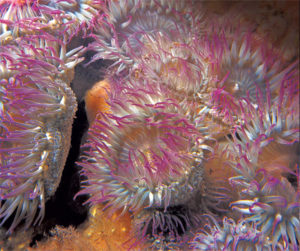 cannot penetrate our skin deep enough to deliver toxin to our bodies’ pain receptors. I learned these facts, and a few others, while researching this article. For instance, did you know that their tentacles can fire venomous miniature harpoons that repel predators and anemones unlike themselves? That a “demilitarized zone” exists between colonies of different clones and species? That colonies are segregated by sex?
Neither did I. In fact, I pretty much took them for granted as a pretty, but rather uninteresting, adornment to the reef. Let’s just say that I’ve changed my opinion about aggregating anemones now that I’ve learned a bit more about them.
Cnidaria is Complicated
Sea anemones are a member of the phylum Cnidaria (the “C” is silent), which means, “nettle” in Greek. Phylum members also include corals, sea pens, gorgonians, jellyfishes and hydroids. All of them are carnivores and all have nematocysts, which are used for defense and catching food.
There are two cnidarian forms; polyps and medusae, described in a book entitled The Shape of Life as “essentially mirrors of each other.” Polyps (i.e., anemones) are attached to a surface on one end by the pedal disk, while the oral disk at the other end is unattached and ringed with tentacles. Medusae (i.e., jellyfish) are unattached, upside down versions of polyps. Sea anemones are always polyps, though the life cycles of some of their cousins include both polyps and medusae.
Writing about sea anemones is rife with pitfalls and not for the faint of heart. Scientific names and classifications change all the time. There are anemones that look so much alike only lab work can determine who’s who. Colors of same-species animals can vary widely. According to the World Register of Marine Species (WoRMS), some sea anemones “are poorly understood.” Try to identify one of those and you may face several possible species names.
For an animal that’s considered “simple,” the sea anemone is surprisingly complicated.
Detailed information on many species of sea anemones is hard to come by. I chose to feature the aggregating anemone, Anthopleura elegantissima, because it is the most abundant anemone found off our coast and quite a lot is known about it. Although it lives in deeper waters, colonies also exist in tidepools and on rocky shores, where they are out of the water during low tides, making them easy for researchers to collect. These anemones also do well in aquariums.
While solitary A. elegantissima exist, the animals usually crowd together in colonies, which always contain genetically identical, same sex clones. The oral disk is about 2.36 inches in diameter and is ringed by approximately 100 tentacles. Aggregating anemones are found from shorelines to 60-foot depths and from Alaska to Baja.
Although aggregating anemones reproduce by cloning, in late summer/early fall they also spawn, with males and females releasing eggs and sperm into the water. When a fertilized egg hatches it releases a free-swimming larva with a flat, oval body. After several weeks, the larva settles down on the bottom and morphs into a polyp. It takes just one polyp to start a colony.
Clonemates from different genetic groups are enemies. When two unlike aggregating anemones come in contact, they inflate their white fighting tentacles (normally retracted at the base of the colored tentacles) and fire poison darts at each other. When the injured anemones withdraw, they leave behind a clearly visible “demilitarized zone.”