
 I have had some of my most incredible diving experiences on beach dives. Many frequent beach divers will testify to the same. All three of my gray whale encounters have been while beach diving, same as my dolphin encounters. Other diving fun that I have had only while beach diving includes staring a mola mola in the eye and watching a massive school of squid in a mating frenzy. While perhaps not unique to beach diving I have also caught lobster, dived with sea lions, giant black sea bass, white sea bass, barracuda, angel sharks, and massive bat rays. Beach diving has many wonderful experiences waiting for you.
Boat diving will never lose its appeal but you’ll find beach diving opening many doors of opportunities. California has some of the best beach diving in the country and it has advantages often not considered.
The Benefits of Beach Diving
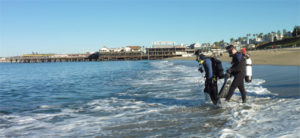 First, it’s relatively inexpensive. You’ll be paying for little more than air fills, some fuel for your automobile, parking fees and perhaps a bite to eat. When I was a teenager and into college this is how I kept diving. Even during the lean years of owning a fledgling business, I was beach diving almost as much as I was boat diving.
Second, you’re afforded flexible scheduling. With the exception of the limitations of conditions and buddy availability, you can pretty much pick where and when to dive. Also, sometimes you can’t set aside an entire day to dive. You can usually complete a beach diving excursion in just a half a day, maybe less.
Third, the risk of seasickness — which is a significant challenge for my wife and dive buddy, Kim — is mitigated. Kim has never succumbed to seasickness on a beach dive.
Finally, there’s variety. You literally have miles and miles of California coastline to explore as a shore diver.
Diving from shore has its challenges, but with the proper training, equipment, and knowledge of the dive sites, you’ll find that beach diving is highly rewarding. Some key factors to consider are the dive site location, its natural features, wave action, timing, and techniques appropriate for the site.
Wave Watching
Perhaps the biggest concern of beach divers is dealing with waves and surf. Some knowledge on wave mechanics is helpful.
An ocean wave is created where the energy of the wind and water interact. This wave energy travels across the sea until it collapses on the shore, in a process known as a wave cycle. Waves are classified by height, wavelength and wave period. The highest part of the wave is its crest, while the trough is its lowest point. Wavelength is defined as the horizontal distance between the crest of one wave and the crest of the next — wave top to wave top. The wave period is the time it takes for two successive waves to pass a fixed point.
As ocean surf waves move closer to shore they break forming surf. The nearshore area where wave water reaches the beach is known as the surf zone.
How surf behaves is often dictated by the shape and makeup of the bottom. If the beach slope is steep, the waves are generally more powerful because they build quickly and expend their energy quickly. These are often called plunging breakers. The good news is that beaches with this kind of surf have short surf zones that can be passed through quickly. If a beach slope is gentle then the surf zone is wider but the waves have less power, with breakers that spill rather than plunge.
When you see divers at a beach dive site staring out to see, they’re not daydreaming. Instead, they’re studying the waves in order to plan their shore entry. If you watch a beach for about 15 minutes you will see that there will be a series of larger waves (usually 3 to 6) followed by a period of smaller waves, or perhaps no waves. The larger waves are known as a set. The time between sets is usually around 4 to 8 minutes. This is important to know, as you will want to time your water entry and exits according to these intervals. Time your entry and exit between sets and between waves for maximum ease.
If waves are hitting the beach at an angle, the net flow of the energy along the beach will be influenced by the direction of the waves. This is known as a longshore current. If you are heading for a specific location offshore you need to take this into consideration as you swim out through this current to the destination. The same goes for the return trip. For the most part longshore current is limited to the surf zone and a short distance outward.
Rip currents (sometimes mistakenly referred to as “rip tides”) are isolated outward flows of water offshore. As moderate to heavy surf pushes up on to the beach the water seeks the path of least resistance to head back out to sea. Troughs in the bottom give the water this flow area resulting in the rip current outward. On a sand beach, rips can usually be spotted from the surface by a plume of discolored, even frothy water heading out to sea on a sand beach. On a rocky beach they are a bit harder to spot, but if conditions are relatively calm you can often see a line of small choppy waves crossing the surf zone; this indicates the presence of a rip current.
In some instances, “riding the rip” out to the dive site can be an advantage, but if you get caught in a rip current do not try to swim against it, directly to shore. Instead, swim perpendicular to it to until you are out of the current before turning towards shore.
Geography Plays a Role, Too
Most of the California coastline down to Point Conception faces west, and the prevailing weather comes in from the northwest. From Point Conception north, beach diving becomes challenging with the exception of the Monterey area with its multiple coastal twists and turns and protected coves and bays.
The north coast also has coves that can sometimes be counted on for protected surf entries and exits but the north coast requires a fair amount of skill and local knowledge best acquired from local dive shops and experienced divers.
At Point Conception the coastline makes a radical turn to the east then curves back around toward San Diego. This is known as the California Bight. Beaches within the Bight are more protected. The offshore Channel Islands also provide a limited amount of swell protection to the coast. Of course it depends on specific location but for the most part southern California beach divers have the luxury of manageable surf 250 days a year or more.
On a local level you may have general areas that have a number of beaches and coves that face different directions. While some face west, some south, and there are even beaches that face north. What this means for divers is that we have choices. In many areas it is possible to find a calm beach somewhere nearby. The Palos Verdes Peninsula, for example, has several alternatives.
If you are scheduling a beach dive with your buddy, try to be flexible about location. If a heavy swell is coming in from the south, head for a protected west-facing beach. A buddy and I had hoped one particular Saturday to dive a south-facing beach along the Palos Verdes Peninsula. Checking out the surf reports online (more on that later) we discovered that a south swell was rolling in and there was a nearby more protected northwest cove. We adjusted our plan. It worked out well and we had an enjoyable dive with a relatively easy water entry and exit.
Data Mining for Diving
When it comes to setting an actual date for a beach dive, be flexible. Much of the time in southern California and often in the Monterey we have the odds in our favor of good conditions in a general area.
Offshore winds, in southern California often referred to as Santa Ana winds, push the cloudy nearshore waters offshore, promoting the upwelling of clearer waters. These offshore winds also tend to lay down the surf. After a day or two of offshore winds, providing the surf is low, beach diving will be outstanding. Drop the golf clubs, abandon the lawn mowers and head for the beach!