
2022 marks the 60th anniversary of the 400-foot pioneering mixed gas dive by Hugh “Dan” Wilson, a former abalone diver, that sparked the deepwater diving revolution. He wasn’t necessarily making the epic dive for fame and glory; Wilson and his team of pioneering dive buddies were interested in finding ways to dive deeper, and safer.
As we sport divers learn during entry-level scuba training, breathing compressed air at deep depths is dangerous. Divers venturing deeper than about 80 feet while breathing compressed air are at risk of experiencing nitrogen narcosis, which causes impaired thinking and changes in consciousness and neuromuscular function. Below about 185 feet, the partial pressure of oxygen in a standard scuba cylinder becomes toxic, causing convulsions that would almost certainly prove fatal to a diver at that depth due to loss of consciousness that would cause drowning.
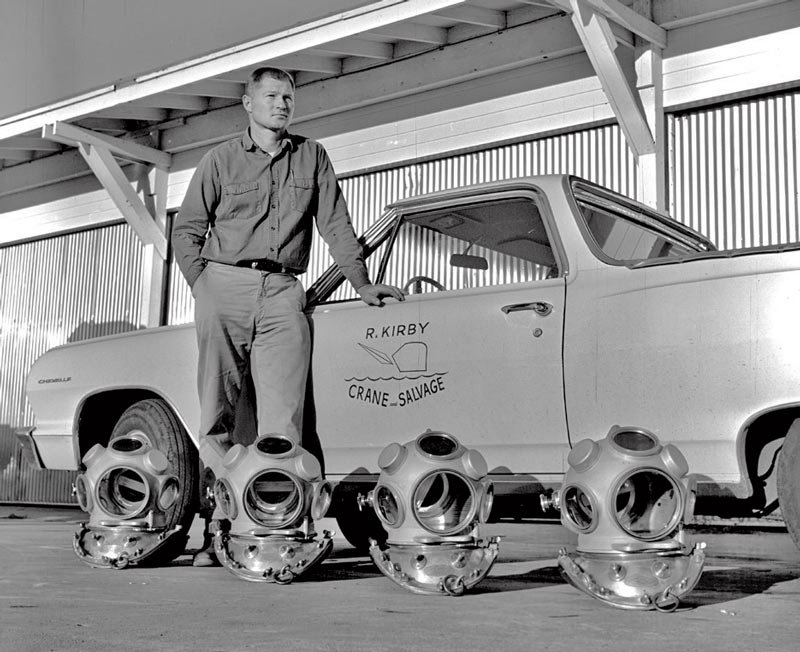
Pioneering Diver Bob Kirby posing with his helium recirculator helmets at Santa Barbara Airport.
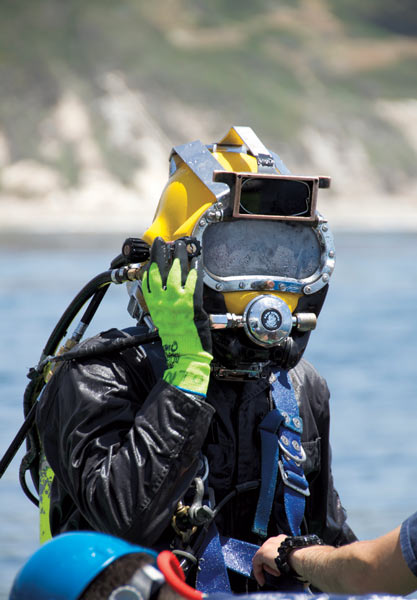
Modern day Kirby-Morgan Superlite® lightweight fiberglass helmet in use off Santa Barbara.
Mixing It Up in the Deep
Wilson cast off from Santa Barbara harbor for his historic dive in relative secrecy on the fishing vessel Rio Janeiro on November 3, 1962. With him was a support crew of abalone divers and some students from Brooks Institute of Photography, who documented his successful record attempt while also doubling as his safety divers on the risky experimental dive.
Wilson safely completed a dive to a depth exceeding 400 feet off the east end of Santa Cruz Island, in the Santa Barbara Channel. To survive at this extreme depth, Wilson used a gas mixture of helium and oxygen, now widely used by commercial and technical divers. Known as Heliox, the gas blend is non-narcotic at depth.
The local newspaper, The Santa Barbara News Press broke the story to the public two days later.
Wilson’s historic dive was the catalyst that created what is known as “The Santa Barbara Helium Rush.” It spawned the development of equipment, technology, support, and training infrastructures that rapidly spread worldwide and revolutionized the trade of both the commercial and military diver. The technology developed in Santa Barbara became the norm for diving operations in the North Sea, the Middle East, Far East, Gulf of Mexico, Venezuela and beyond. It remains in use in commercial and sport/technical diving operations today.
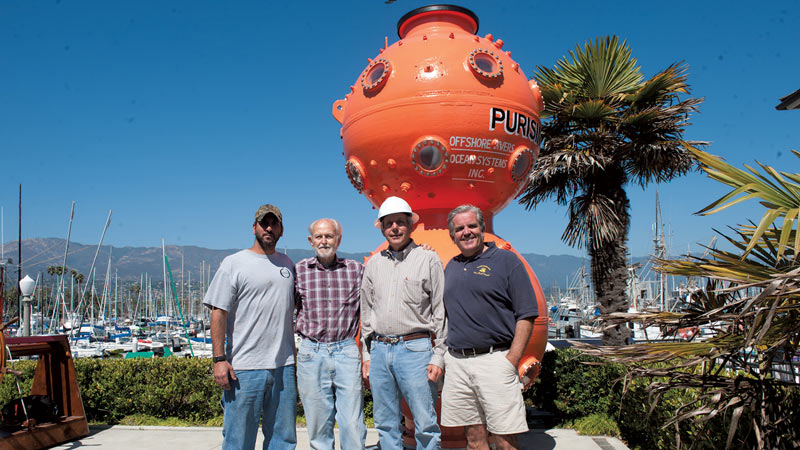
Restored Purisima Diving Bell returns home in-front of Santa Barbara Maritime Museum in 2011. L-R SBCC student diver Omer Sfar, Purisima Diver Bob Christensen, Seth Hammond (Owner Specialty Crane, BCC Professor Don Barthelmess).
Ringing the Helium Bell
Throughout the 1960s and ‘70s, the commercial diving industry saw big changes in equipment that had previously remained unchanged for many, many years. Traditional copper and brass heavy-gear helmets for surface gas dives were being replaced by modern lightweight headgear, with divers being deployed from closed diving bells.