
The lingcod’s scientific name, Ophiodon elongatus, appropriately means “elongated snake tooth.” Lingcod are the largest of the greenling family Hexagrammidae. Aliases include cultus cod, blue cod, green cod, buffalo cod and white cod. These names are a bit of a misnomer; lingcod are not actually cods.
Though these fish can grow to lengths of 60 inches and weigh over 80 pounds, they easily camouflage into their surroundings. The species sports unique color variations: their colors range from gray to reddish-brown to a bright blue-green with copper-colored spotting.
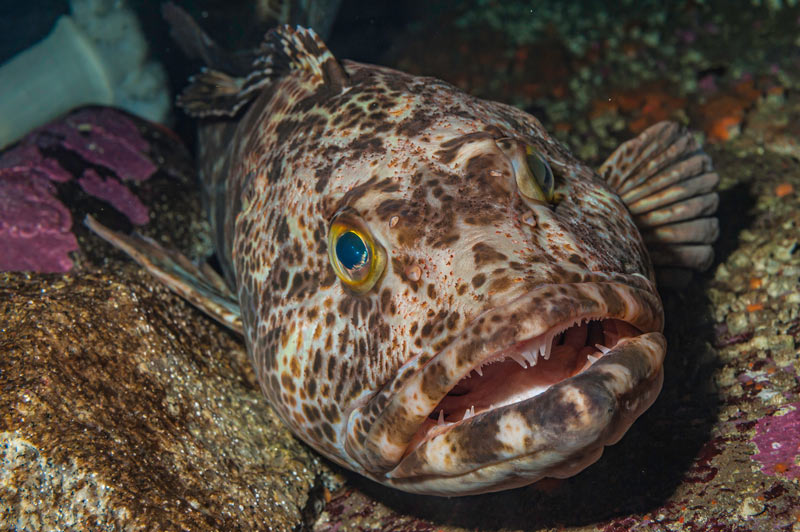
Lingcod have 18 razor-sharp teeth.
Lingcod are found in Pacific waters from Alaska to Baja California. If you encounter a lingcod on a dive, it is most likely a male. Males tend to make shallow waters home, favoring rocky ledges, pinnacles and strong currents (to bring them prey…these lazy bubbas love to eat). Females prefer deeper waters and can be found up to 330 feet deep.
Winter is spawning season. Beginning in October, males set up shop in the rocky substrate (though they rarely travel far — lingcod lack a swim bladder and are a nonmigratory species). The females make their way to the nesting grounds several weeks later and leave as soon as they deposit eggs. Female lingcod can produce anywhere from 60,000 to 500,000 eggs during mating season, with the egg mass weighing up to fifteen pounds. The male is tasked with safeguarding the nest for the eight-to-ten-week incubation period and may watch over multiple nests simultaneously. They will aggressively defend the egg mass against predators, including rockfish and crabs; they’ve even been known to attack humans during spawning season. The eggs will be eaten almost immediately if the male dies or is chased away from the nest. (Be mindful of this if you come across lingcod guarding their nests.)