
That a fish would leave the water and fling itself onto a beach at night in order to produce future generations seems preposterous. That it would need to factor in high tides and full/new moons when determining the right time to do so, stretches the limits of credibility. Yet California grunion do all these things.
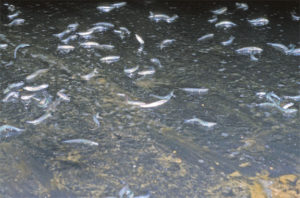 Reaching a maximum length of eight inches but usually only six, California grunion (Leuresthes tenuis) range from northern California to southern Baja. Leuresthes comes from the Greek for smooth and to eat and tenuis is Latin for slender.
Grunion spawn on the highest tides of the second, third and fourth nights following the new and full moons. The fish only spawn on sandy beaches, coming ashore in the thousands with incoming waves. On the beach, the females flop around until they find suitable terrain out of the water. Then they stand on their tails and wiggle them to dig a hole. When half of their bodies are buried they deposit their eggs.
Meanwhile, the gentle waves are bringing males, who flop around on the beach until they find a female, no matter that she may already have (or had) other suitors. The males wrap themselves around the females and release sperm, called milt, which resembles a small cloud of smoke. The milt runs down the females’ bodies and into the sand around them, fertilizing the eggs.
The males return to the sea immediately. They will spawn again that season. The females may have their eggs fertilized by any number of males and may or may not spawn again that season. They can release up to several thousand orange eggs and, when they are finished, wait for the next wave to take them out to sea. Spawning runs can last only a few minutes or as much as an hour.
Tides bury the eggs until they are covered by six to eight inches of damp sand. When they hatch depends upon the water temperature (61 to 81 degrees F is considered ideal) and when a set of high tides uncovers and agitates them. When conditions are not right, the eggs will remain unhatched for up to 35 days after fertilization.
Spawning is mainly from March through August, although this year there was considerable spawning in February. Grunion runs occur from Point Conception to Point Abreojos, Baja, usually after 10:30 pm.