
Even though our local kelp forests support as many as 800 marine species, they can’t hold a candle to coral reef ecosystems, which are among the most productive and complex ecosystems on Earth. They provide shelter, places of attachment, nurseries, and food for many organisms, in addition to protecting vital mangrove swamps and shorelines from erosion.
TAXONOMY
Corals are animals. They are described in the phylum Cnidaria and the class Anthozoa. All cnidarians possess stinging cells, a fact reflected in the name Cnidaria, a word derived from the Greek for “stinging nettles.” All hard (aka stony and reef-building) corals are described in the order Scleractinia.
RANGE
The majority of reef-building hard corals occur in tropical and subtropical waters around the world.
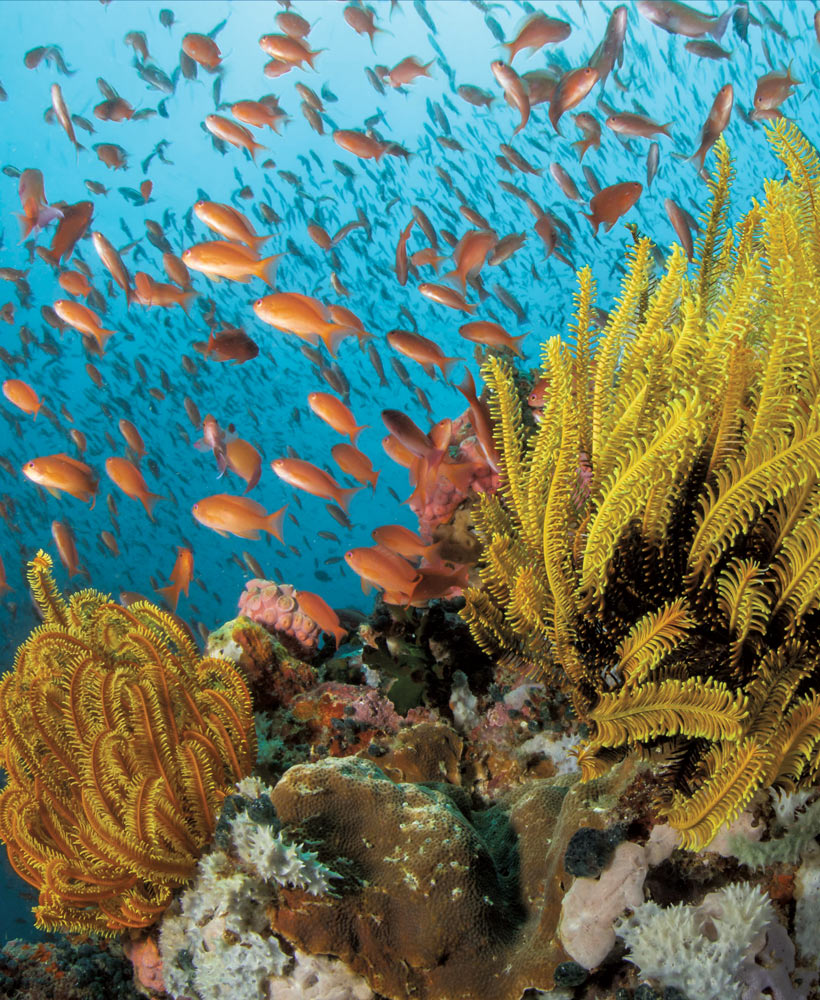
Witnessing a coral reef community is certain to fill you with a sense of awe as you view a stunning array of fishes, sun dappled hard corals, sea fans, soft coral trees, crinoids, sponges, and more.
HABITAT
Most hard corals occur in areas where the year-round water temperature is between 73.4 and 84.2 degrees F. Many species die if the water temperature drops below 64.4 degrees F for any length of time, while some can survive water temperature as high as 104° F for brief periods.
Hard corals require sunlight and relatively clear water, so most are found between the surface and 230 feet. They also require between 32 and 42 parts per thousand of salt in the surrounding water.
There are three basic kinds of coral reefs; fringing reefs, barrier reefs, and atolls. Fringing reefs usually border a coastline, although some are separated from land by a slender body of water. Barrier reefs are separated from land by a lagoon. They develop parallel to land with the reef’s outline being a near mirror image of the shoreline. Ring-shaped atolls develop when islands surrounded by reefs collapse into themselves. Atolls isolate a central lagoon from the open ocean.
CLOSE UP
Using their pedal disc, individual polyps of hard corals attach to rocks and other hard substrate. Each polyp has a cylindrical body topped by an oral disc equipped with a centered opening that serves as both mouth and anus.