
One of the first things I learned when I moved to California in 1975 was that the garibaldi (Hypsypops rubicundus) was California’s official state fish. It was something I heard over and over again. The problem was that although widely believed, this information was not true. To some degree there has been and still is some confusion about the status of this iconic fish.
Today, the garibaldi is officially recognized as California’s state marine fish. The golden trout (Salmo aguabonita, also written as Salmo agua-bonita) is designated as the official state fish.
In this article I will share the story of how the garibaldi became designated as our state marine fish and reveal many fascinating aspects of the natural history of this beloved species.
The Garibaldi’s Path to Becoming California’s State Marine Fish
Because of the garibaldi’s beauty, popularity, limited stock, and the realization that the fish was not widely sought after as a food source, in 1971 the California Department of Fish and Game recommended to the State Legislature that the garibaldi be fully protected. This protection would mean garibaldi could not be taken for sport or commercial reasons. However, despite what many people believed, this recommendation was not acted upon.
For the next 22 years, commercial fish collectors targeted garibaldi because of its strong popularity with hobbyists and the fact that these damselfish are relatively easy to catch. In addition, a small number of spearfishermen were known to pursue garibaldi. Sad, but true.
In 1993, legislation was passed that was intended to protect garibaldi from being over harvested. Live captures were prohibited from February 1st through October 31st. Even so it was widely believed that commercial collectors continued to greatly reduce the garibaldi population in many areas, and in 1994 Assembly Bill No. 77 was introduced with the intent of putting a collecting moratorium in place so the state’s garibaldi population would recover. The bill was enthusiastically backed by a grassroots campaign led by Jean-Michael Cousteau’s Ocean Futures Society.
Not surprisingly, however, amendments slowed the bill’s passage. Finally, in September of 1995 the bill was signed into law by then Governor Pete Wilson on October 16, 1995. The bill contained a section that designated the garibaldi as California’s official state marine fish. As a result, the garibaldi is protected. Today, removing a garibaldi from the waters off California requires a special permit, not just a valid fishing license.
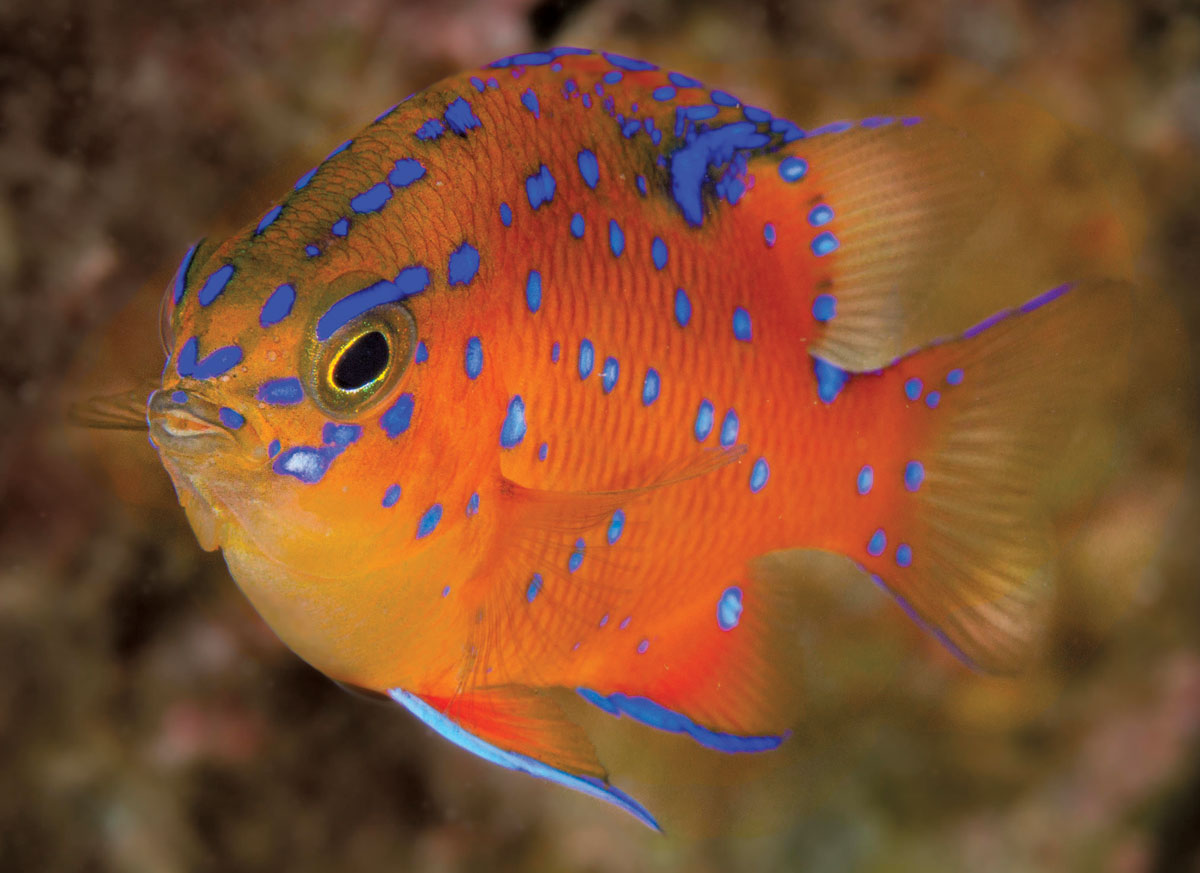
The brilliantly colored reddish-orange bodies of the juveniles are covered with iridescent blue spots.
A Darling Damsel
The garibaldi is a member of the damselfish family, Pomacentridae, a grouping that includes approximately 392 species described in 30 genera. Attaining a maximum length of approximately 15 inches (38 cm), the garibaldi, Hypsypops rubicundus, is believed to be the largest member of its family.
Occurring in tropical and temperate seas around the world, damselfishes tend to inhabit relatively shallow water, as is the case with the garibaldi, a species that prefers to inhabit rocky reef communities in the top 100 feet (30 m) of water. However, there are family exceptions with some damselfishes being present in areas as deep as 1,250 feet (381 m). While known in all tropical seas, the greatest numbers of damselfishes inhabit the waters of the Indo-Pacific.
Damselfishes are commonly described by divers as being feisty, pugnacious and irascible. Many species are known for their vigorous defense of their territory and their willingness to physically confront intruders—including divers—many times their size. Inhabiting reef communities, the individuals of most damselfishes species typically remain close to the sea floor where they feed on bottom dwelling organisms such as algae, myriad invertebrates, and fish eggs. However, those species described in the genus Chromis feed on planktonic organisms in mid-water.
Although there are numerous exceptions, many damselfishes are characterized by their brilliant coloration, a characteristic that is especially evident in juveniles. While it is not a trait that stands out to laymen, a single nostril on each side of their snout is another feature that characterizes damselfishes. Most other species of bony fishes possess four nostril openings with a pair being located on each side of the head. Most damselfishes have bodies that are flattened from side to side, and generally disc-like. While bearing some resemblance to angelfishes and butterflyfishes, many damselfishes are easy to distinguish by noting that they look like “pug-nosed perches.” However, the species described in the genus Chromis are an exception. These damselfishes have longer bodies and distinctly forked tails.
The 104 species of damselfishes described in the genus Abudefduf are commonly referred to as types of sergeants, examples being the sergeant major and Indo-Pacific sergeant. Various species of sergeants occur in tropical seas throughout the world and often grace the photographs of postcards from exotic locales. These fishes routinely gather in loose aggregations in coral reef communities as well as close to debris and boat docks. In many respects, the behaviors exhibited by sergeant majors are like those exhibited by the garibaldi.
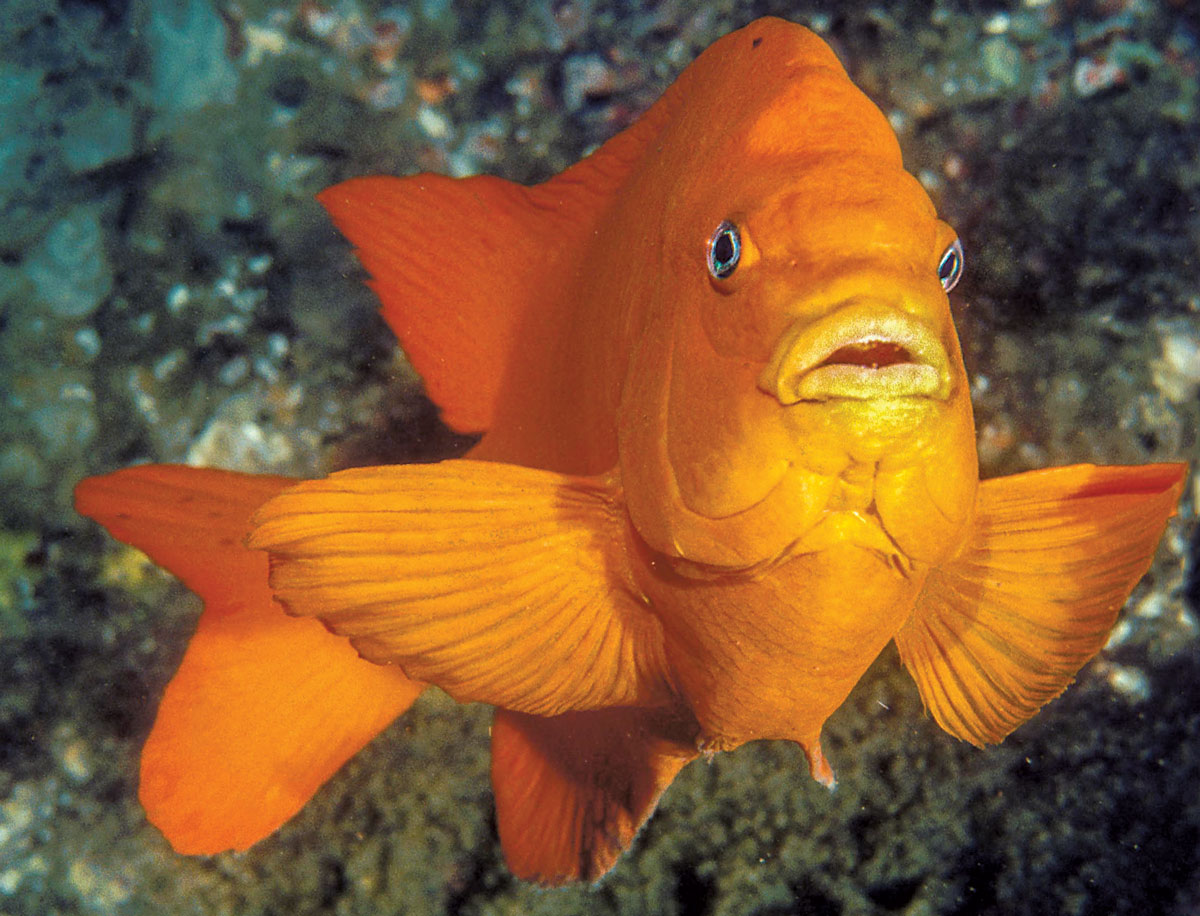
An adult garibaldi poses for the camera.
‘Baldi Basics
The garibaldi occurs in reef communities and kelp forests ranging from central California’s Monterey Bay southward to Magdalena Bay, a well-known birthing ground of California gray whales located roughly halfway down the Pacific coast of Mexico’s Baja peninsula. Garibaldis are also present at Guadalupe Island off the northern portion of central Baja, a destination widely known to divers as a site to see great white sharks. Within California waters, divers and snorkelers are more likely to encounter garibaldi the further south we explore, and it is quite common for beachgoers to spot their brilliant reddish-orange bodies from the shoreline as garibaldi dart through the shallow waters of rocky reefs and tide pools that are close to nearby kelp beds.
The common name, garibaldi, is believed to be a reference to the Italian military and a prominent political and military figure of the mid-1800s, Giuseppe Garibaldi, whose followers often showed their allegiance by wearing a bright reddish-orange shirt.