
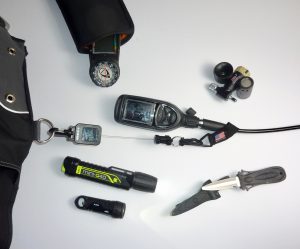
 When I hit the dive center for tank fills I inevitably find myself cruising the equipment area, marveling at the display of gadgets and gizmos designed to improve my diving experience. Over the years I’ve dropped a few coins on scuba accessories, and I have to admit, only a few of these gadgets have become permanent additions to my gear bag and dive kit. The rest have ended up in the dive gear storage area of our garage, in a box labeled, “Misc. Dive Gear.”
I decided it’s time to declutter my dive gear collection. I’m not a devotee of Japanese tidying-up expert Marie Kondo or anything – I don’t expect my life to be transformed by cleaning the garage – but I know it’ll feel good to free up some storage space and have my dive gear and accessories better organized. And you’ll enjoy a side bennie of my cleaning spree, too, as I’ve decided to share my “must have” list of dive gear accessories here.
Surface marker buoy. First on my list is a big, bright inflatable safety sausage, which is also called a surface marker buoy or SMB. A diver floating at the surface can be difficult to spot without one. You owe it to yourself, your buddy, your loved ones – and the boat crew – to carry a safety sausage on every dive. I have used mine more than I have used my dive knife. It is a must for signaling not just in current or isolation but also in an emergency on beach dives or even during a lake dive.
I have one with a pocket on the underwater end for a line and small weight. I keep 15 feet of line in the pocket with the sausage on one end and the weight on the other. It makes a great safety stop buoy. It lets me signal my location to the boat crew before I surface, so I spend less time bobbing at the surface waiting to be picked up. This model also has a clear sleeve at the top for a chemical glow stick, and a grommet for attaching a strobe, yet it’s still compact enough to fit inside my buoyancy compensator (BC) pocket.
Personal locator beacon. Here I’m referring to my Nautilus Lifeline Marine Rescue Global Positioning (GPS) unit. Although I’ve never had to actually use this compact but high-tech emergency-signaling device, it gives me peace of mind to know that I have it. It’s small enough to fit in a BC pocket. In the event of a “missing diver” situation, you can use the PLB to relay your position to nearby boats and emergency personnel.
Audible signaling device. This can be a simple low-tech whistle that you blow into when on the surface, or a sophisticated DiveAlertPlus2™ device that emits sound both at the surface and underwater. On the surface, the sound has reportedly been heard from a distance of more than a mile.
Cutting tools. We used to joke that the reason divers carry big knives strapped to their legs is so that if they see a shark approaching they can stab their buddy and swim away! I know, bad joke. And as much as I admit my fondness for the big commando-style dive knives of old, the smaller ones now on the market are pretty cool. I have one made of titanium that’s nearly indestructible, with a super-sharp blade and a serrated edge, too. Instead of strapping it to my leg, it’s small enough to attach to my BC and has a quick-release sheath designed for easy, one-handed use.
Line cutters and EMT shears also make my list of must-haves, especially for those who are diving in areas that might have a lot of monofilament line.
In recent years it seems dive knives have become viewed as optional accessories. I think this is wrong. Every diver should carry a cutting tool suited to cut through a variety of entanglement hazards, including fishing line, rope and kelp.
Dive lights. Even if you’re not into night diving, every diver should carry at least a small dive light. These compact, inexpensive lights fit into a BC pocket and are useful for exploring cracks and crevices where small, colorful creatures reside. If you are into night diving you’ll want a bigger light and a medium-sized backup light. Great advances in lighting technology have been made in recent years. If it’s been a while since you checked out the lighting options now available for divers, ask the people at your dive center. You’re in for a treat. Ask about headlamps that allow hands-free lighting. And ask about marker strobes, too. Like I said, new technology. There are some pretty cool lighting options out there.
Straps and springs and snag-preventers. We all know it’s important to secure our gear and streamline our equipment to avoid entanglement and also protect the delicate underwater environment. But did you know that there are a bunch of really nifty gadgets designed to help you achieve this?
One of the worst culprits when it comes to kelp entanglement is a loose fin strap. Put spring straps on your shopping list. They eliminate four possible snag points and make it easier to slip fins on and off. And because they provide a snug fit they’re comfortable to wear and lessen the likelihood that you’ll accidentally lose a fin. They are relatively simple to install on most fin styles, so I urge you to switch out your old-school straps for springs. You’ll be glad you did.
When it comes to accessory items for securing and streamlining your gear, your dive center has lots of options, from lanyards to retractable gauge clips and specially designed retainers for your safe-second regulator and gauge console. Go over these options with a gear specialist who can help you select the accessories that are right for you and the type of diving you do.