
I eventually decided to get closer by using scuba. Bad idea. It set our relationship back a month. Did I just say “relationship”?
Finding Spot hunkered down in his den I was able to relax close by observing for hours with my big tank in the shallow water. Eventually Spot moved closer to the entrance but I never saw him venture forth again. Even so, it was those encounters at his home entrance that meant the most to me.
As I would approach, his eyes would dilate, and the texture and color of his skin would change. Excited to see me? Probably not, but it entertained me to think he might recognize me.
After a couple of dives I moved in closer trying to get a better angle. This was when I spotted the eggs. It turns out, “he” was a female. And a mama. No wonder she was staying put.
I continued to check on her for a few more weeks, and then one day she and the eggs weren’t there.
Kim and I continued to look for octopuses, hoping for more special encounters but while none would match Spot, other extraordinary encounters would follow.
Under the Newport Pier a small curious octopus crawled up on my hand. On another beach dive at Gladstone’s in Malibu an exceptionally large octopus climbed onto Kim. It decided to explore her regulator and mask a bit too aggressively, so she had to gently push it away.
As exciting as these encounters are, they are rare. Octopuses can be curious but most of the time they are very shy.
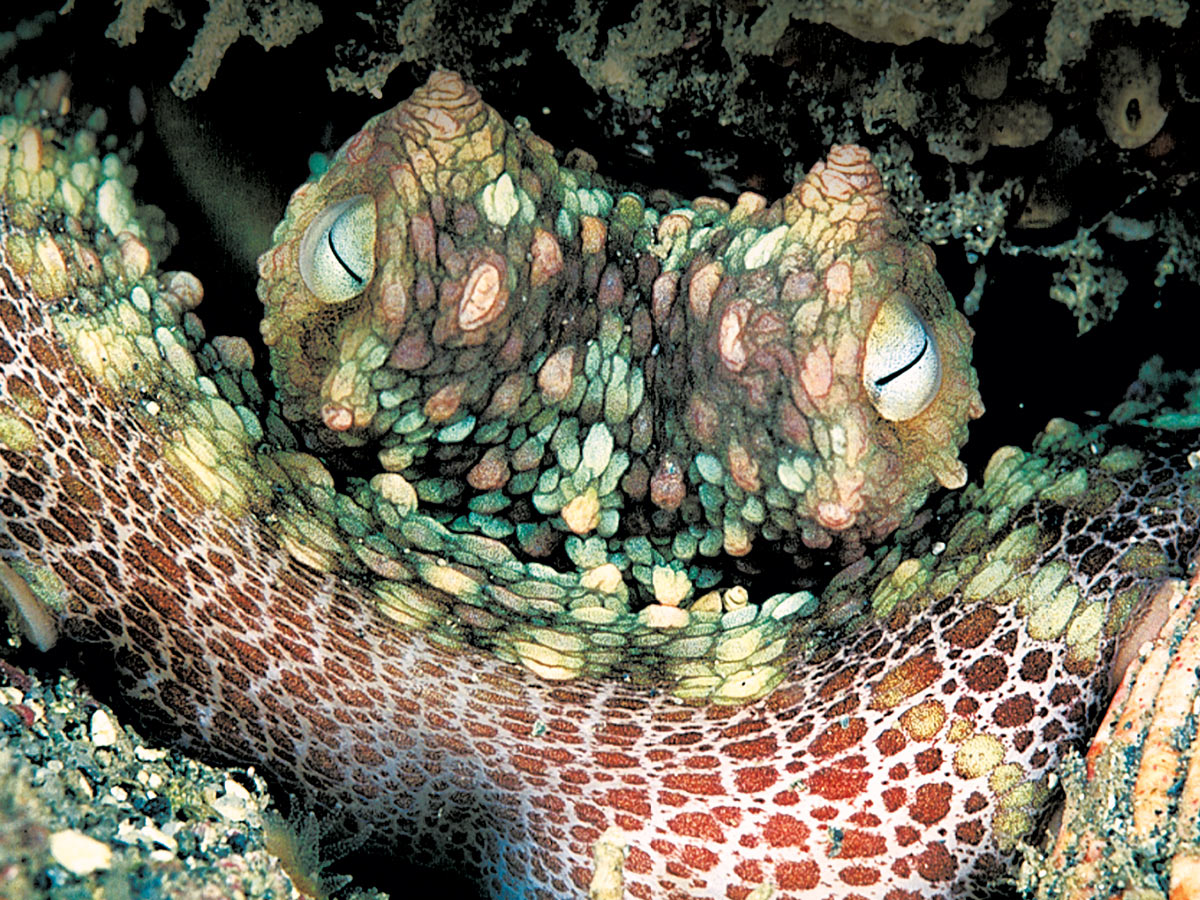
Using tiny organs in its skin known as chromatophores the octopus can change its pigment in a flash for camouflage and to express moods. Eye pupils also indicate its level of excitement. Photo by Dale and Kim Sheckler.
How to Up your Octo Odds
Octopuses are more common on California reefs than one might think but because they are masters of camouflage it’s likely you’ve swam right past them on your dives. If you want to see them, move slowly, and look for the clues.
Perhaps the best way to find an octopus is to find its den where it hides out of sight most of the day. Just like Spot they venture forth to gather food they will often drag back to their dens to feed on at their leisure. Some of their more common foods are crabs and small fish but they also enjoy small clams. It is the empty clam and mussel shells that are the best clue to the den whereabouts.
As you cruise across and around reef edges look for small pockets and crevices with an unusual amount of clam shells scattered about. Peek inside the small dark hole and you stand a pretty good chance of seeing an octopus. They simply cast off the empty shells into their trash heap, which is also known as a “midden.” In addition, they like to pile up other empty shells for added protection at the entrance to their den.
Here are a few tips to try if you find an octopus in its den.
First, approach low and slow. Like many ocean creatures they are sensitive to sudden movements. You will also find them sensitive to your breathing, not that you can do much about that (unless you are free-diving or using a rebreather) but you can breathe rhythmically, slow and steady. Relax. They are remarkably intelligent and can probably sense your state of mind. You can use the rumble of your bubbles to your advantage. Predators simply don’t make a lot of noise like we do. We announce our approach. Even so, don’t pounce on them. Slow down.
As you draw close, pay attention to the dilation of their pupils. They will fluctuate with your movements, contact with the reef and their midden which is part of their home territory. If you are carrying a camera, be careful not to bump into anything. Notice that the octo’s pupils will likely fluctuate with your breathing. It is interesting to watch and makes for good video if you can draw in for an up-close and personal macro image. Be patient. It takes time to develop the trust.
If you can get low enough look up at the roof of the crevice and you might spot some eggs. This indicates a nesting female. This will assure you the female will not flee but will hunker down even closer to protect her brood of eggs.
Females will not eat when guarding their eggs. In fact, they slowly starve to death as they tend to their clutch.
While you can occasionally see octopus out in the open any time of day, your best bet is at dusk and dawn. What you do when you find an octopus out in the open will have a lot to do with the quality of your encounter.